
FirstBank CEO: Agriculture, Exports Can Drive Nigeria’s Economic Diversification
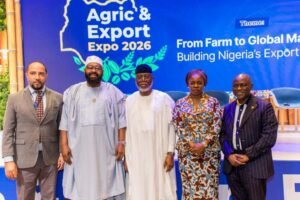
The Chief Executive Officer of FirstBank Group, Olusegun Alebiosu, has identified agriculture and non-oil exports as important areas through which Nigeria can broaden its economy and reduce dependence on traditional sources of foreign exchange.
Alebiosu spoke at the opening of the fifth FirstBank Agric & Export Expo 2026 in Lagos, where stakeholders from the agricultural, financial and export sectors gathered to discuss ways of strengthening Nigeria’s position in global markets.
The two-day event is themed “From Farm to Global Markets: Building Nigeria’s Export Value Chain.”
From farming to global markets
According to Alebiosu, the agriculture and export expo has developed from a platform primarily focused on awareness and industry discussions into a forum designed to encourage practical partnerships and measurable business outcomes.
The event brings together farmers, processors, exporters, investors, financial institutions and policymakers to examine challenges across the agricultural value chain.
He said FirstBank’s focus is increasingly centred on helping businesses move from production to processing, financing, market access and ultimately international trade.
Unlocking Nigeria’s non-oil export potential
Nigeria has significant agricultural resources, but industry stakeholders have repeatedly highlighted the need to move beyond exporting raw commodities.
The emphasis at the expo was therefore placed on strengthening the entire value chain, including production, storage, processing, packaging, logistics and access to international markets.
Lagos State Governor Babajide Sanwo-Olu, represented at the event, similarly called for greater value addition so that Nigerian agricultural commodities can compete more effectively in global markets.
Examples highlighted included processing cassava into products such as starch and ethanol and converting cocoa into cocoa butter, liquor and powder before export.
Financing remains a major issue
Another major issue discussed at the event was access to suitable financing.
Agricultural businesses often operate according to planting, harvesting and processing cycles, making conventional short-term lending structures difficult for some operators.
Stakeholders therefore called for financing models that better reflect the realities of agribusiness and provide businesses with the capital needed to expand production and processing capacity.
States seek stronger agricultural value chains
State governments participating in the event also highlighted ongoing efforts to increase agricultural production and develop processing capacity.
Niger State Governor Mohammed Bago called for greater investment in agriculture, while Ondo State Governor Lucky Aiyedatiwa highlighted efforts to strengthen cocoa production, processing, traceability and export.
Lagos State also pointed to investments in infrastructure, storage, cold-chain logistics and agro-industrial development as part of efforts to connect farmers with larger domestic and international markets.
FirstBank pushes execution-focused approach
FirstBank said this year’s expo represents a deliberate move away from discussions alone toward practical implementation.
The bank’s 2026 programme includes business matchmaking, exhibitions, technical sessions and networking opportunities intended to connect participants across the agricultural and export ecosystem. FirstBank says more than 2,000 participants and 100 exhibitors are involved in the event.
Alebiosu said stronger collaboration among stakeholders could help unlock opportunities in agriculture and non-oil exports while contributing to Nigeria’s broader economic diversification efforts.
With agriculture capable of supporting food production, employment, foreign-exchange earnings and industrial development, stakeholders at the expo are pushing for stronger links between farmers, processors, financiers and international markets.
The focus, increasingly, is not just on what Nigeria produces, but on how much value the country can add before those products reach consumers at home and abroad.
About The Author