
Nigeria’s Food Inflation Climbs to 20.31% in July, Highest in 10 Months
Nigeria’s food inflation rate accelerated sharply in July 2026, rising to 20.31% year-on-year, as consumers faced renewed increases in the prices of several essential food items.
The latest figure, contained in the Consumer Price Index (CPI) report released by the National Bureau of Statistics (NBS), represents a significant increase from the 17.52% recorded in June and marks the highest food inflation rate recorded since September 2025.
The July increase comes despite a broader moderation in Nigeria’s inflation rate. Headline inflation eased to 15.43% in July, down from 15.91% in June, indicating that while overall price pressures moderated, food costs moved in the opposite direction.
Food prices reverse earlier moderation
Nigeria’s food inflation had been on a downward trajectory towards the end of 2025 and early 2026. The rate fell from 20.16% in September 2025 to 16.30% in October and 14.21% in November.
It declined further to 10.84% in December and reached a low of 8.89% in January 2026 before beginning a sustained upward movement.
Food inflation subsequently climbed to 12.21% in February, 14.31% in March, 16.06% in April, 16.96% in May and 17.52% in June, before reaching 20.31% in July.
The latest data therefore represents an increase of 11.42 percentage points from the January level, highlighting the rapid reversal in food-price trends during the first seven months of the year.
Monthly food inflation also accelerates
On a month-on-month basis, food inflation rose to 5.56% in July, compared with 3.75% in June. This represents a 1.82 percentage-point increase and signals that food prices continued to rise significantly within the month.
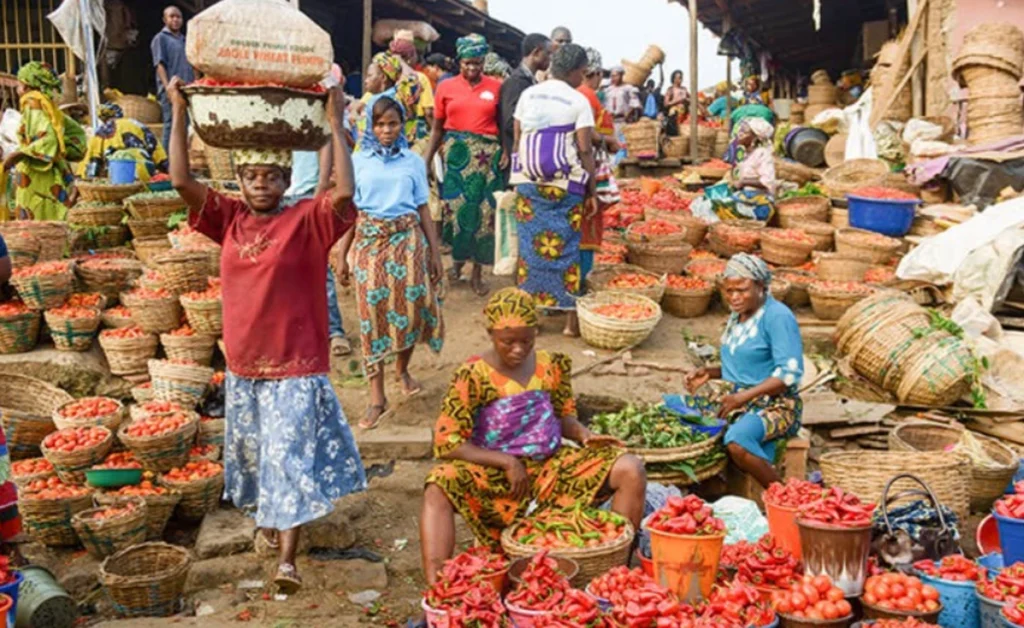
According to the NBS data, the increase was influenced by higher average prices for several food products, including crayfish, pepper, onions, carrots, rice, water yam, tomatoes, garri, plantain, beef, eggs, guinea corn, ginger and plantain flour.
Food inflation remains below last year’s level
Despite the sharp month-on-month and recent year-on-year increase, July’s food inflation rate remains below the 26.20% recorded in July 2025.
This suggests that food prices are rising at a slower annual pace than they were a year earlier, even though the recent acceleration presents renewed pressure for households and businesses.
The divergence between headline and food inflation also highlights the continuing challenge of translating improvements in broader inflation indicators into lower food costs for consumers.
Regional disparities remain significant
Food-price pressures varied considerably across the country. On a year-on-year basis, Adamawa recorded the highest food inflation at 51.36%, followed by Katsina at 30.84% and Zamfara at 30.65%.
The wide differences across states underline the uneven impact of food-price pressures, with households in some parts of the country facing substantially faster increases in the cost of basic food items than the national average.
Outlook for consumers and policymakers
The renewed acceleration in food inflation is likely to keep the cost of living at the centre of economic discussions, particularly for households whose spending is heavily concentrated on food.
The development also presents a challenge for policymakers, as efforts to bring down headline inflation may not immediately translate into relief at food markets.
With food inflation now significantly above headline inflation, sustained improvements in agricultural production, supply chains, transportation, storage and market efficiency will remain important to achieving more durable moderation in food prices.
For consumers, the July data provides a reminder that the easing in headline inflation does not necessarily mean that everyday living costs are falling. Rather, it indicates that the pace of overall price increases has slowed, while food prices have entered a renewed period of acceleration.
About The Author